
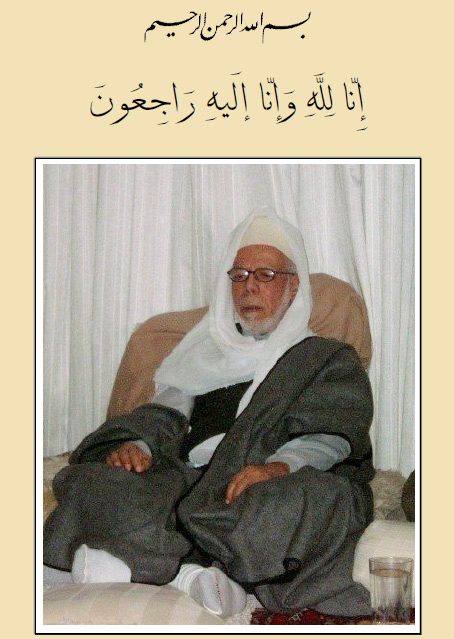
Shaykh Ibrāhīm Muḥammad al-Baṭṭāwī Abū Dhikrī was born in Cairo in 1924 (1343 AH) and passed to the realm of barzakh on the 14th of Rajab, 1430 AH — the 8th of July, 2009 — surrounded by his family. His ancestors, from the sādāt of the Prophet Muḥammad ﷺ, had come to Egypt from the Maghreb in the time of Ṣalāḥ al-Dīn al-Ayyūbī, their migration made with the explicit intention of restoring sacred knowledge according to the way of Ahl al-Sunna wa-l-Jamāʿa in a land that had lost much of it under the long era of Fatimid rule. His kunya, “Abū Dhikrī” — Father of Remembrance — was no incidental designation. It named the man’s essence: one whose entire being was permeated by the remembrance of Allāh and who made the transmission of that remembrance the animating purpose of his long life.
He was formed at al-Azhar at a time when that institution had not yet been assaulted from the many quarters that would later beset it. He was a Mālikī ʿālim, though he taught the works of Imām Abū Ḥāmid al-Ghazālī for twenty-five years, becoming fully acquainted with the madhhab of Imām al-Shāfiʿī and familiar with the Ḥanafī school as well. As an Azharī of his era, he was a committed adherent of the Ashʿarī approach in theology. He was a ḥāfiẓ of the Qurʾān and of numerous aḥādīth; a master in the Arabic language, admired universally for his ability to always choose precisely the right word; and celebrated for the subtle, luminous quality of his supplications (duʿāʾ) to his Lord. He was a contemporary of Shaykh ʿAbd al-Ḥalīm Maḥmūd, the great mujaddid of twentieth-century Egypt and Shaykh al-Azhar, and both men inhabited the same spiritual and intellectual world, embodying the best of their generation in the living fusion of ʿilm and taṣawwuf.
Alongside his teaching, Shaykh Ibrāhīm left a small body of written work. Two devotional texts bearing his name were published in Cairo through Dār al-Insān li-l-Taʾlīf wa-l-Tarjama li-l-Nashr: Miftāḥ al-Ism al-Aʿẓam wa-Ṭarīq al-Wuṣūl ilā Allāh (1992, 127 pp.) and Rawḍat al-ʿĀbidīn: Zād al-Rūḥ li-kull Muslim (1993, 127 pp.) — companion volumes, issued a year apart through the same publisher, that carried his teaching on the remembrance of the Divine Name and the sustenance of the spirit into print for a wider readership beyond his immediate circle of students.
Those who wrote about him after his passing struggled, with characteristic honesty, against the limits of the task. One of those who knew him — who signed himself al-faqīr al-Shādhulī — opened his memorial eulogy with a reflection drawn straight from the tradition: “We are taught that no one truly knew the Prophet ﷺ as he could be known, because they had not reached his rank. Yet those who knew him best were the Companions. We are likewise reminded that no one knew the Companions as they truly were, for the same reason, but that the next generation knew them best. How incredible it is, therefore, to speak of the teacher, the shaykh, the ʿālim, the lover of Allāh and His Prophet — for truly, we were not of his rank, in order to really know him.” The epistemological caution is fitting: Shaykh Ibrāhīm was a man who actively refused to be known, preferring to remain veiled by the principle the Shādhulī masters describe as ittikhāfāʾ — self-effacement — what one great shaykh of that way described simply as “More glow… and less show.”
While an accomplished jurist and theologian of the written sciences, those close to him knew him primarily in his role as a shaykh of the ṭarīqa of Imām Abū-l-Ḥasan al-Shādhulī. He may have taught the works of Imām al-Ghazālī, the Imām of the Sufis on the path of murāqaba — those who worship Allāh even if they do not see Him, knowing that He sees them — but that was for the external practice of Islam. For inwardly, Shaykh Ibrāhīm al-Baṭṭāwī was a man of jadhb, of Divine attraction, following the way of those who worship Allāh as though they see Him. It was to this path that he dedicated himself for most of his long life, in the service of his Lord. His own formulation of this distinction has been preserved among his students: “Our way is the Way of Jadhb. Our beginning is their end. Their beginning is our completion. Whoever is illumined in the beginning is illumined in the end.” This is the language of the majdhūb — one drawn by Allāh before the self has been formally trained — a type familiar in the later Shādhulī tradition, resonant with the inner character of Sīdī Abū-l-ʿAbbās al-Mursī and Sīdī Yāqūt al-ʿArsh al-Ḥabashī before him.
His primary and most direct spiritual authorization came through one of the great luminaries of twentieth-century Egyptian Sufism: Sīdī Salāma Ḥasan al-Rāḍī, the founding master of the Ḥāmidiyya-Shādhiliyya and widely regarded as the mujaddid of the Shādhulī way in Egypt in the modern era. Behind Sīdī Salāma’s own authorization lie two lines of transmission going back to Sīdī Abū-l-ʿAbbās al-Mursī’s two great spiritual heirs: the written line (silsila qalamaniyya), carried through Sīdī Ibn ʿAṭāʾillāh al-Iskandarī, whose Ḥikam became the defining text of the Shādhulī tradition; and the oral line (silsila shafawiyya), carried through Sīdī Yāqūt al-ʿArsh al-Ḥabashī — the extraordinary Ethiopian-born companion and spiritual heir of al-Mursī, described by his master as “my son” and by later biographers as ajall al-talāmīdh, the most eminent of his disciples.
Sīdī Salāma’s own published silsila — the “Golden Chain” (al-Silsila al-Dhahabiyya) preserved by the Ḥāmidiyya-Shādhiliyya in his name — traces his Shādhulī authorization to his shaykh, quṭb al-zamān Sīdī ʿAlī Marzūq al-Mālikī, and from him to Shaykh Muḥammad al-Bāhī ibn Aḥmad ibn Yūsuf al-Miṣrī (buried in Ṭanṭā), and onward through a chain of Egyptian masters — ʿAbd al-Dāʾim al-Rashīdī, al-Abūtījī, al-Ajhūrī, the al-Qarāfī and al-Bakrī lines, Nāṣir al-Dīn Ibn al-Milaq and Aḥmad Ibn al-Milaq of Alexandria — to Sīdī Yāqūt al-ʿArsh al-Ḥabashī, Sīdī Abū-l-ʿAbbās al-Mursī, and Imām Abū-l-Ḥasan al-Shādhulī himself.
Sīdī Salāma’s formation, however, drew on more than this single chain. As a young man he was also a member of al-Makkiyya al-Fāsiyya, the branch founded — and, in the tradition’s own telling, renewed for a new century — by Imam Fāsī, whose own teacher, Shaykh Muḥammad ibn Ḥamza Ẓāfir al-Madanī, had himself taken the ṭarīqa from Mawlānā al-ʿArabī al-Darqāwī. He later entered the Qawuqjiyya-Shādhiliyya of the Lebanese scholar and Shadhuli shaykh, Shaykh Muḥammad ibn Khalīl Abū al-Maḥāsin al-Qawuqjī al-Ṭarābulusī (1224–1305 AH/1809–1888 CE), at the hands of the order’s founder, al-Qawuqjī himself — a personal transmission attested both by the silsila published by Shaykh Ibrāhīm al-Baṭṭāwī’s own ṭarīqa and, independently, by historian Dr. ʿUmar Muḥammad al-Sharīf. Al-Qawuqjī had himself taken the Shādhulī khirqa at al-Azhar from the same Shaykh al-Bāhī who appears as the second link in Salāma’s own golden chain — so the line he received personally from al-Qawuqjī and the line he later published as his own converge on the same figure. He went on to serve as khalīfa of the Qawuqjiyya for the district of Būlāq. Sīdī Salāma subsequently founded his own order, the Ḥāmidiyya-Shādhiliyya, which he described — per de Jong — as coming by divine command (amr Allāh) through a true vision (ruʾyā ṣādiqa); the Egyptian Majlis al-Ṣūfī formally recognized the order at the end of 1906.
Sīdī Salāma formed and commissioned Shaykh Ibrāhīm, transmitting to him the accumulated inheritance of his lines, which converge, several links further back, upon al-Mursī’s two heirs, Ibn ʿAṭāʾillāh and Yāqūt al-ʿArsh al-Ḥabashī, and beyond them upon al-Mursī and Imām Abū-l-Ḥasan al-Shādhulī himself. Among those who gathered around Sīdī Salāma al-Rāḍī’s spiritual orbit was the Swiss-French metaphysician René Guénon (ʿAbd al-Wāḥid Yaḥyā), who attached himself to his line in Cairo — a testimony to the universality of what Sīdī Salāma carried. It was this same master who named Shaykh Ibrāhīm Shaykhu-l-Afandiyya — Shaykh of the Effendis — and charged him with the formal duty of teaching and guiding the non-Egyptian Muslim students coming through Egypt for their studies. Shaykh Ibrāhīm was only in his twenties when he received this commission. He fulfilled it, without interruption, for over half a century.
The practical center of his life was the zāwiya. He maintained two. The first was a small space a few minutes’ walk from the Azhar mosque in Old Cairo, where every year he would identify a few students who appeared drawn to certain principles and teach them privately, transmitting knowledge of the classical canon in the traditional manner — the student reciting, the shaykh clarifying the meanings as time went on, and the ḥaḍra held in its proper time. The second, established in later years, was in Heliopolis (Miṣr al-Jadīda), which also served as a mosque, with a hostel for students and a clinic for the care of the sick attached to it — a model he followed when building mosques in other parts of Cairo as well. He often gave the khuṭba in the mosque of Sīdī Ibn ʿAṭāʾillāh al-Iskandarī, maintaining a living and physical connection to the spiritual topography of Cairo as a sacred city.
His students were literally from all around the world, and they did not come to him out of widespread fame — he made sure of that. Not all who attended the ḥaḍra were his murīds; they could be from other ṭarīqas, and his own murīds were free to attend other gatherings. He typically kept only a small number of students under close attention at any one time. Once he was satisfied that they had the tools to live as true conscious Muslims inwardly and outwardly in a world of temptation, he would permit himself to take on more, leaving the first to work on their nafs with what they had been given. When one drank tea after attending his ḥaḍra — which was always, as al-faqīr al-Shādhulī recalls, “sublime, peaceful and somber, yet powerful and elegant” — one could find oneself in conversation with Indonesians, Turks, Russians, Britons, Pakistanis, Americans, and people of many other nations. It was in this way that his teachings reached Korea and Singapore, England and America. The Orisons of the Shādhdhuliyyah, compiled and translated under his direct supervision in Alexandria between 1988 and 1994 and later published in Singapore, became one of the primary vehicles through which the Shādhulī aḥzāb entered the Anglophone world and, through Singapore, the broader Southeast Asian Muslim readership.
Across every account left by those who knew him, a portrait of his character emerges that is strikingly consistent. He was a man of gentle compassion, of piercing knowledge, of impeccable character, of deep contemplation, of generous hands — brave with his generosity to the point that much of his external simplicity of life was simply the result of having given so much away to poorer students and others. He was fierce against falsehood and against unbridled attachment to the dunyā, but sweet with every person who came to see him. He slept very little during the night and regularly spent those hours reciting the Qurʾān and in munājāt — intimate conversation — with Allāh, even into old age. He never extended his feet, even when sitting alone, because he never felt absent from Allāh’s vision. He loved orphans and said many times that no one can build a sound connection with Allāh while ignoring them. He was always looking for new opportunities to make duʿāʾ for someone. When one of his students once showed him a large Moroccan-style prayer beads, he quietly produced his own — tiny, unnoticeable. He preferred that people know Allāh more than knowing him, because “Allāh is greater and more everlasting,” as the Qurʾān says, and his whole bearing was shaped by this preference: subtle, limpid, self-effacing.
His way was built on clear foundations. He called for absolute attachment to the sharīʿa and abhorred any suggestion that success in taṣawwuf could be reached outside its bounds. He reminded his students to attend to their dreams, which the Prophet ﷺ described as a portion of prophecy. He directed them to the orisons (aḥzāb) of Imām Abū-l-Ḥasan al-Shādhulī, certain in the inexhaustible value of those gathered duʿāʾ. He insisted they spend a portion of every day in the study of the sharīʿa and in recitation of the Qurʾān. And he said clearly, without ambiguity, that one of the governing conditions of his way was to guide people to the truth of Islam through love — emphasizing that word very strongly — and that no price or profit in this world could ever be taken for this work; it was for Allāh, and for Allāh alone, with absolute sincerity. His last words of teaching to one of his students, when that student expressed that he needed to physically be near the graves of the righteous to feel their presence, were: “Realize that there is NO distance when it comes to the rūḥ.”
Shaykh Ibrāhīm formally authorized and commissioned Shaykh ʿAbdallāh Nūruddīn Durkee as his khalīfa in the Western Hemisphere, granting him an ijāza for teaching, preaching, and taking the bayʿa in 1406 AH / 1986 CE. Shaykh Nūruddīn established the Green Mountain Branch of the Shādhdhulī School for Tranquility of Being and the Illumination of Hearts in Charlottesville, Virginia, and became the primary vehicle through which the Baṭṭāwī-Shādhulī transmission took root in North America. He compiled and translated the two-volume Madrasat al-Shādhdhuliyya — Orisons of the Shādhdhuliyyah and Origins of the Shādhdhuliyyah — under the direct supervision of Shaykh Ibrāhīm himself in Alexandria, producing the most comprehensive authorized English-language presentation of the Shādhulī aḥzāb and awrād.
Among the other students who sat with Shaykh Ibrāhīm in the earlier part of his life was Shaykh Dr. Hisham. Eventually, Dr Hisham received an ʿijāza in the Shādhulīyya from Shaykh Ibrāhīm’s chosen successor in Cairo, Shaykh Salah Muhammad Salih. Later in his journey, Dr. Hisham was accorded the traditional ijāza in the Islamic sciences by Shaykh Seraj Hendricks of Cape Town — the South African sage and khalīfa of Sayyid Muḥammad ibn ʿAlawī al-Mālikī of Mecca — and was subsequently designated as his muqaddam in the ṭarīqa, announced publicly at the Azzawia mosque in Cape Town on the 19th of Ramaḍān, 1437 AH. The chain thus traces from Shaykh Ibrāhīm al-Baṭṭāwī to Dr. Hisham to his role as muqaddam of Shaykh Seraj Hendricks — a remarkable web of transmission connecting the Egyptian Baṭṭāwī-Shādhulī line to the Cape Town–Makkan Idrīsī-Shādhulī-Bā ʿAlawī tradition.
Shaykh Ibrahim al-Battawi was taken from this world on the 14th of Rajab, 1430 AH, surrounded by his family in Cairo. At his passing, Sīdī Zayn al-ʿĀbidīn wrote: “The Muslim umma has lost an ocean of knowledge and spirituality. In him, the streams of sharīʿa, ṭarīqa, maʿrifa, and ḥaqīqa had merged together to form an ocean of immense vastness… For the scholars, he was an ocean of knowledge; for the people of iḥsān, he was the pole of our time; and for the umma, he was the replica of the Prophetic sīra, full of love and mercy.” And al-faqīr al-Shādhulī, who closes his eulogy with the words Shaykh Ibrāhīm himself had given: “We may never see the likes of him again — but as he reminded one of his students: in the realm of the spirit, distance means nothing.”
His legacy endures through the Shādhuliyya-Baṭṭāwiyya active in Egypt, Turkey, Indonesia, America, and Singapore; through his two published devotional works and the authorized editions of the Shādhulī aḥzāb compiled under his personal supervision; through the students he formed who became teachers and transmitters of the tradition across three continents; and through the mosque, zāwiya, clinic, and student hostel he built in Heliopolis — a material expression of his deepest conviction: that the path of love for Allāh cannot, and must not, be separated from love for Allāh’s creation.
May Allāh Most High sanctify his secret, illuminate his resting place, and allow the umma to continue benefiting from the baraka of his chain. Al-Fātiḥa.
