
🌙 Introducing a Blessed Series: “Dalīl al-Khayrāt: Prayers upon the Prophet ﷺ”
In the below transcript of a video from Noor Al-Muhibeen (نور المحبين), Shaykh Muhammad Haydara al-Jilani, a blessed Prophetic grandson of the noble saint Shaykh ‘Abd al-Qādir al-Jīlānī (may Allah be pleased with him), guides us through the spiritual depths of sending salawāt (blessings) upon our beloved Prophet ﷺ, exploring the transformations that occur in our hearts and lives through this blessed practice.
Below is the complete transcript of this beautiful episode. May it benefit us all and draw us closer to the Messenger of Allah ﷺ.
📜 TRANSCRIPT 📜
The Command of Allah to Send Blessings upon the Prophet
“Indeed, Allah showers His blessings upon the Prophet, and His angels pray for him. O believers! Invoke Allah’s blessings upon him, and salute him with worthy greetings of peace.” (Qur’an 33:56)
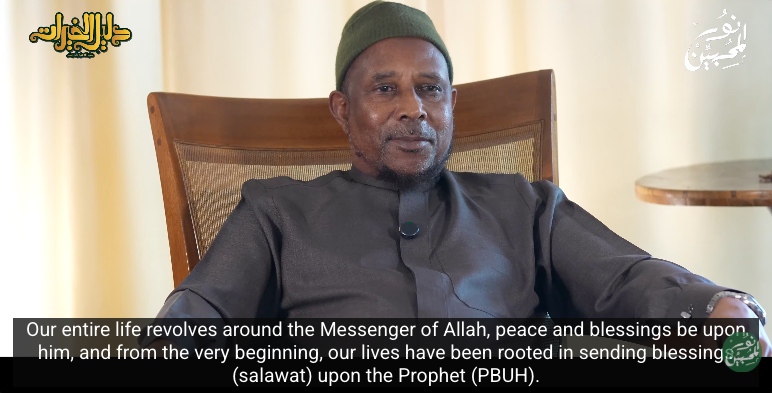
Our entire life revolves around the Messenger of Allah, peace and blessings be upon him, and from the very beginning, our lives have been rooted in sending blessings (salawāt) upon the Prophet (PBUH). We were raised in an environment where everything was accompanied by invoking salawāt upon the Prophet (PBUH), before eating, after eating, and at the start of anything people did.
Even after the obligatory prayer, if you go to any of the villages where we were raised, the very first thing people do is invoking salawāt upon the Prophet (PBUH). Sending salawāt upon the Prophet is what one is nurtured upon in such an environment and grows up with; indeed, our entire lives, when we first opened our eyes, we opened them to this world accompanied by sending salawāt upon the Prophet (PBUH).
The Path to Divine Closeness Through Adab
The more a person’s love for the Messenger of Allah increases, the closer they draw to Allah, and the Divine Presence is a presence of proper etiquette (adab). The Prophet (PBUH) attained closeness to Allah through adab, and one emerges from this divine school with adab: “My Lord disciplined me, and He perfected my discipline.”
This was the first testimony granted to the Prophet; therefore, whoever seeks spiritual refinement, goodness, and success in all that they do, must abide by invoking salawāt upon the Prophet (PBUH) as a constant companion throughout their life—otherwise, there will be no true success.
Everything we witness in our world today—of widespread problems and conflicts—is the result of distancing ourselves from the Prophet (PBUH). Sending salawāt upon the Prophet is what draws you closer to him; it is the first step one takes to draw nearer to the Messenger of Allah (PBUH).
Knowledge Illuminated by the Heart
The more you send salawāt upon the Messenger of Allah, the closer you come to him, and the closer you draw to him, the knowledge you acquire becomes filled with wisdom and clarity. So that you are then able to apply this knowledge in every aspect of your daily life.
A person may gather vast amounts of knowledge and memorize countless books, yet gain no real benefit from any of it. This is because there is a dimension of the heart through which true understanding occurs, and by which the light of Allah Almighty is perceived. If this dimension is lifeless, then knowledge itself becomes lifeless, nothing more than a heavy burden one merely carries. And thus, no benefit is derived from it.
The Gateway to Allah
Whoever seeks to benefit others through their companionship should know that sending salawāt upon the Prophet (PBUH) is the key to all goodness. If you wish to enter the Divine Presence of Allah, there is no way except through the Messenger of Allah (PBUH). If you do not draw near to him, how can you enter through this door?
This misunderstanding also confuses people. There are those who take the lead in gatherings without sufficient knowledge, and who give rulings according to their own whims, thereby distancing people from the Messenger of Allah (PBUH). Whoever distances themselves from the Messenger of Allah, distances themselves from all goodness and from Allah Himself.
Your closeness to Allah is directly linked to your closeness to the Messenger of Allah. The stronger your bond with him, the clearer your path to Allah becomes. The path to Allah, the Almighty, is through the Messenger of Allah, peace and blessings be upon him; he is our gateway, as Allah has commanded in the Qur’an.
“Indeed, Allah showers His blessings upon the Prophet, and His angels pray for him. O believers! Invoke Allah’s blessings upon him, and salute him with worthy greetings of peace.” (Qur’an 33:56)
Even here, Allah addresses the believers directly: “O you who believe.” Yet some among Muslims still question the importance of sending salawāt upon the Prophet.
The Light-Filled Heart of the True Believer
Drawing closer to the Messenger of Allah (PBUH) was therefore emphasized. The true believer’s heart is always open, filled with light that guides them to the ultimate truths. Indeed, the more one sends salawāt upon the Messenger of Allah (PBUH), the more one’s knowledge deepens.
Today, there are many scholars with vast knowledge, but have they truly solved the problems of the Ummah? No! Why? Because they are distant from the Messenger of Allah (PBUH) and from his wisdom.
Returning to the Origins of Islam
We are often preoccupied with advanced sciences, elaborate theories, and philosophy, yet we forget the very beginning of the call to Islam. In Mecca, the solutions to the Ummah’s problems lie in returning to the origins of the call—in the house of Arqam ibn Abi Arqam, when the Messenger of Allah (PBUH) was at the start of his mission, continuing until he reached Medina.
Consider what he endured in Ta’if, in Mecca, through migration, and even during the conquest of Mecca—he did not seek revenge. He left vengeance to the Avenger, Allah, Glorified and Exalted; he was a Prophet of mercy.
We must follow the Messenger of Allah (PBUH) in the steps of his life. We must return to him and to the beginnings of Islam. As Muslims today, we need to revisit the origins of Islam, to understand how it began, so that we may return to the straight path. We must start our journey from there. We began at the end, after Islam had already spread everywhere, and without returning to its origins, we lost our way. Returning is essential.
The Crisis of the Self
Knowledge alone will not save us today. Knowledge is everywhere; anyone can sit in their room and study. I believe what cannot save us are the souls. The real problem lies in the self. We may have correct belief, jurisprudence, and all kinds of knowledge, but if a person does not confront and purify the self, then mastering all the sciences will be useless.
It will only worsen the problem. If they speak, they may divide the Ummah; if they act, they may harm everyone. Therefore, all our efforts must focus on managing the soul inclined to evil. This is the greatest self; it must be guided from the harbor of the commanding soul to the shore of the tranquil heart.
Only then can one be truly saved, having purified oneself. This journey must be completed, otherwise the self remains dominant, following the path of Iblis (satan). This is one of Iblis’s strategies. Many of us compete in knowledge not to contribute, while in the past, scholars learned a small portion of knowledge and bore fruit from it because they applied it. Today, people study and memorize countless books, yet often only display it outwardly.
Returning to Sound Spiritual Guidance
We must return to sound spiritual guidance. We should follow the methods and example of our scholars and righteous saints, so that we may rise above these conflicts. We return to purity and to a sincere, true love for our master, the Messenger of Allah (PBUH) without ever seeing this love as excessive.
The more love we offer to the Messenger of Allah (PBUH) the more we realize it is never enough—how could it ever be considered exaggeration?
Sitting with the Righteous
Our Sheikhs, the righteous saints, the divinely guided scholars—one must sit with them, attend their gatherings, and be in their presence. Then one begins to rise spiritually and taste the sweetness of love for the Messenger of Allah (PBUH). Only then does one grasp the realities and see that there is nothing in this love that constitutes shirk (associating partners with Allah) or contradicts Allah’s law.
From this, we understand that no matter how much love we give to the Messenger of Allah (PBUH) it will never be sufficient; we can never offer enough. All those who praise the Messenger of Allah from the beginning of time until the Hour—even they, in expressing their love, have not reached the reality of true love.
Divine Love for the Prophet
He is loved by Allah, Glorified and Exalted. It is Allah who loves the Messenger of Allah (PBUH) and He has made our relationship with him one of love for the Messenger of Allah. No one who praises the Messenger of Allah from the beginning of time until the Hour can truly give even a fraction of what is due; they are only expressing their own love.
True love, however, cannot be attained unless we reflect on all the goodness, mercy, and kindness that the Messenger of Allah carries for us and for this Ummah. Only then do we realize that we can never truly give him what he is owed.
The Spiritual Chain of Love
Even if a person loves something for the sake of the Messenger of Allah (PBUH) that love becomes connected to his spiritual chain. Through this chain, the love for the Messenger of Allah links you to his presence. These are steps, but if the heart is distant from Allah, there remains a gap. Yet guidance reaches those who are far, for He is always near.
Thus, love for the Messenger of Allah (PBUH) is like this: when you love the saints, why do you love them? It is because of their love for the Messenger of Allah (PBUH). They are our means of reaching love for the Prophet, for they know him more intimately than we do.
If the Messenger of Allah opens the door of knowledge to them, they understand the meaning of sending salawāt upon him. They also understand the essence of true love, for the source of all love is Allah, Glorified and Exalted.
The Leader of All Lovers
But the leader of all lovers is our master, the Messenger of Allah (PBUH). To love him is to truly become among those who know Allah. Love for the Messenger of Allah is the key to knowing Allah.
The Mercy of Allah and the Defeat of Satan
Our understanding of Allah, the Almighty, comes from knowing His gentleness, mercy, and goodness; therefore, we do not judge anyone. Satan’s schemes are ultimately doomed to fail. For instance, he may work on a person for eighty years, trying to corrupt and lead them astray, yet the moment that person sincerely turns to Allah, Glorified and Exalted, Satan is defeated—because Allah loves those who repent and purify themselves. Then, standing before Allah, we know that our Lord loves us.
If Allah loves you, how can Satan harm you? All those years Satan worked on the human soul, yet he is limited to deception and manipulation. He tries to deceive us, making us feel: “You keep stumbling, falling, returning, and repenting—clearly you are corrupt.”
Satan urges us not to return to our Lord, the Almighty, and not to listen to Him. A person should not follow the ego but listen to the heart, for the ego’s messages come from Satan, whereas the heart’s guidance comes from the spirit, and ultimately from Allah, Glorified and Exalted.
The Prophet of Mercy
Truly knowing the Prophet (PBUH) is impossible; what we know for certain is that he is a Prophet of mercy. We follow him and love him, and through that love for the Messenger of Allah (PBUH) he guides us closer to Allah.
A heart filled with love for the Messenger of Allah allows one to taste the sweetness of Paradise even while in this world.
Divine Inspiration in Sending Salawāt
When our Lord commanded us to send salawāt upon the Messenger of Allah (PBUH), He inspires each person in a unique way. Certain words, specific forms, and unique methods in sending blessings upon the Prophet (PBUH), and in praising him, are gifts from Allah, Glorified and Exalted, granted to His chosen servants.
He knows which hearts are attached to His beloved (PBUH) and He inspires them with words, expressions, wisdom, and methods of sending blessings and praise for the Prophet.
The Vast Ocean of Knowledge
Knowledge is vast; it is not limited—it is like an immense ocean. Some fish in it, some catch shrimp, others gather pearls or coral. Whatever they cast their nets for, they gain something. This is fitting, for the ocean of the Messenger of Allah is immense. No one can claim to use only specific words—they occupy special stations of closeness.
It is their relationship with the Messenger of Allah that allows Allah to grant them His support and inspire them with certain prayers, and even poems about the Prophet (PBUH) things you may never have heard before. Sending blessings upon the Messenger does not require formal learning.
From our experience and travels in the desert and elsewhere, you may find that some of these people are even illiterate. If someone tells you that they authored these prayers or poems, do not doubt that these inspirations are from Allah, bestowed because of their love for the Messenger of Allah (PBUH) and their deep connection with their Lord—they have no doubt.
This knowledge comes from Allah, Glorified and Exalted. It is not necessary to study books; do not seek it only in texts. Seek it in sending salawāt upon the Prophet, for our Lord commanded it—first upon Himself, then upon the angels, and then upon the believers. It is thus a profound key to abundant knowledge.
Purifying the Heart Transforms the World
Purify your heart, and Allah will purify what surrounds you. When a person reforms their heart, Allah reforms their environment, including the people they interact with, because sending blessings upon the Prophet and remembering Allah brings a certain energy—positive, transformative energy. When you share even a portion of this energy with someone, it can change their life.
The Danger of Judging Others
Turning away from the truth leads to misjudging others. The greatest challenge lies within the self, the ego, because we constantly judge others but fail to judge ourselves. When you are unable to see your own faults, you consider yourself above others, while those below you can see your flaws, even as you think you are seeing theirs.
Being preoccupied with the faults of others makes you forget your own. Judging others is a grave mistake. Saints do not judge anyone, because they understand that a person, even in their final moments, may turn sincerely to Allah, Glorified and Exalted. Someone may be in a coma, repent, and return to Allah, and we would never know, for their conversation is solely between them and their Lord. Sometimes, a coma is a form of spiritual cleansing.
How, then, can anyone judge others? We entrust their affairs to Allah, Glorified and Exalted, which is the essence of having good assumptions about people, for He is Forgiving and Merciful.
Islam is Not Poverty
It is not a requirement to avoid earning wealth, or to live without a beautiful home or a luxury car. One may not possess these, but what matters is what is in the heart. In fact, in our time, it is a duty to show others that Islam is not poverty, disease, backwardness, or ignorance. Islam is knowledge.
The Qur’an is the Book of Allah; it leaves nothing out. All the knowledge we see today is contained in it. If a person does not seek it, they will not attain the sciences.
Lessons from Al-Isrā’ wal-Mi’rāj
The story of Al-Isrā’ wal-Mi’rāj teaches us that even this new technology was hinted at in the journey itself. We should reflect on it: the story of Al-Isrā’ wal-Mi’rāj and the incredible speed involved between Mecca, Medina, and Al-Quds (Jerusalem), and then ascending to the first heavens and returning in almost the same minutes, demonstrates for us today the concept of speed in everything. Today, you can travel from here to an airplane, then to Medina—perform ablution here, pray Dhuhr here, and ‘Ishā in Medina.
If you had said this a thousand years ago, no one would have believed it. But Al-Isrā’ wal-Mi’rāj was a message to us that such possibilities exist. As Muslims, we should be the first to recognize it, the first to use it, and the first to benefit from it. Unfortunately, we often think it is only for others and fear it.
Using Technology for Good
We must see it as a blessing from Allah, rather than something to fear. The internet, for example, can be dangerous if you do not know how to use it. Muslims must learn it, master it, and teach others how to use it responsibly. Even a car—if misused—can harm you.
Everything is like this. Poverty is not a requirement on the path. Sustenance is from Allah, and we pursue it with good intentions—to serve our families, Muslims, and the entire Ummah. Many of the problems we face today stem from backwardness. If you have cameras or technology, why not use them? Others misuse them to spread corruption. We can use them positively to reach out, educate, and benefit others.
Drawing Close Through Salawāt
So that we may draw close to him, because he is our teacher, guide, and mentor. If we do not send blessings upon him, how can we approach him? How can we learn from him if the one teaching this knowledge feels distant?
Sending salawāt upon the Prophet draws me closer to him, giving true meaning and sweetness to his remembrance.
The Miracle of the Prophet’s Life
We deeply seek to understand what true love means—the love for the Prophet Muhammad, (PBUH). This is not a simple matter, nor is it about just any ordinary person. The Prophet (PBUH) is a unique figure in history; no one like him has ever appeared.
He was born and raised in the desert, without attending formal universities. Yet this is proof of the greatest miracle: how he was able to solve challenges that still baffle even modern institutions like the United Nations. Even addressing a fraction of these issues would be nearly impossible. The Prophet (PBUH) received revelation, upheld the truth, and yet, despite being wronged, he did not seek revenge.
The Power of Forgiveness
We carry the spirit of forgiveness—that is the secret of success. But if someone clings to grudges, refuses to forgive, and harbors resentment in the heart, it becomes a heavy, burdensome weight. Holding onto hatred, ill will, and unforgiveness is a weight with no benefit. Why bear it?
Let it go, so that you may receive Allah’s blessings. The moment you forgive, you gain—you lose nothing. You cast away the inner “garbage” that harms you—illness, spiritual coldness, and distance from Allah—and instead receive light, goodness, blessings, and inner peace.
You also open the path to Paradise. When the Prophet, peace be upon him, forgave the people of Mecca and said, “Go, you are free,” what was the result? The greatest intercession. The intercession for the major sinners of my Ummah—if he had held grudges and sought revenge, would this have been granted? He is a Prophet of mercy, and we must follow him, study his life, and adopt his teachings.
Following the Example of Mercy
We must love him, cling to him, and ignore those who claim that this love is innovation or exaggeration—it is a mistake to believe them. If we study the life of our master, the Prophet (PBUH)—his conduct and how he dealt even with his enemies—who else in the history of the Prophets can compare?
If someone harms you daily, yet you notice their absence and inquire after them, checking if they are well—this is different from someone who merely brings you breakfast every morning. The one who harms you, yet you still care for their well-being—this is the Prophet of mercy. This is whom we must love, follow, and, if needed, sacrifice for with our very lives.
Other Deen Discourses
