
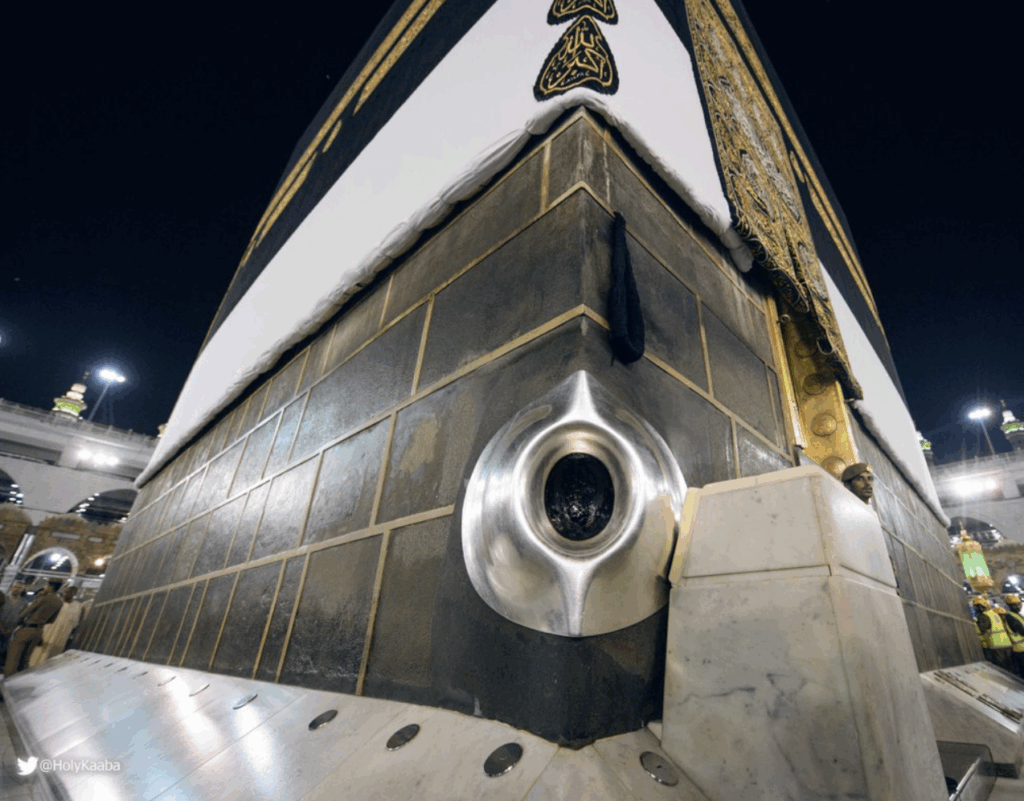
The Black Stone did not begin as an object among objects. The historians and exegetes relate that it descended from Paradise at the dawn of human history, radiant and white, bearing a purity not of this world. Ibn Kathīr transmits the well-known report that it came down whiter than milk, and that neither fire nor age darkened it, but rather the sins of the children of Adam. From the very outset, then, the Stone stood as a sign bound to human moral history rather than as a source of independent power.
When Abraham, peace be upon him, was commanded to raise the foundations of the House, the Stone was already part of the divine economy surrounding the Kaʿbah. Ibn Kathīr situates it within that sacred moment of construction, placed by prophetic hands not as an idol to be enthroned, but as a marker set in obedience to command. As the scholars make explicit, the purpose of the Stone was never the veneration of matter itself, but compliance with divine instruction—what is notable here is the sincerity of the worshipper who pays respect because that is what is required, not because of any power inherent in the stone itself.
When the Prophet Muḥammad, God’s blessings and peace be upon him, came, he neither removed the Stone nor elevated it beyond its appointed place. Ibn Ḥajar records that the Prophet touched and kissed it, thereby establishing orientation for the community. This act clarified the nature of the ritual. As Ibn Taymiyyah would later state with precision: “The Stone is touched in imitation, not in veneration” (al-ḥajr yustalam ittibāʿan lā taʿẓīman). The act was not an invitation to sacralize matter, but a discipline of following. Ibn al-Jawzī captured this distinction in a single maxim: “Reverence is directed to the One who commands, not to the object commanded” (al-taʿẓīm innamā yakūn lil-āmir lā lil-maʾmūr).
It was ʿUmar ibn al-Khaṭṭāb, however, who voiced this most starkly. Standing before the Stone, he addressed it directly, declaring: “I know that you are a stone that neither harms nor benefits” (innī aʿlamu annaka ḥajar lā taḍurr wa-lā tanfaʿ). As al-Ghazālī would later articulate: “Whoever seeks blessing from the Stone itself has acted out of ignorance” (fa-man ṭalaba al-baraka min al-ḥajar li-dhātihi fa-qad jahila).
The Black Stone was being kissed not because it possessed agency, but because the Messenger of God, peace and blessings upon him, had done so. In this act, Ibn Ḥajar discerned something deeper than mere imitation: “In touching the Stone there is pure compliance, for the intellect has no role in determining its designation” (wa-fī istilām al-ḥajar al-inqiyād al-maḥḍ, idh lā majāl lil-ʿaql fī taʿyīn jihatihi). The Stone thus became a training ground for submission without rational cause, a place where obedience preceded explanation.
Yet the tradition did not empty the act of inward meaning. Abū Ḥāmid al-Ghazālī described the moment of touching the Stone as a moment of covenant, not mere contact. He writes: “It is as though touching the Stone were a handshake renewing the covenant with Allah” (ka-anna istilām al-ḥajar muṣāfaḥa ʿalā tajdīd al-ʿahd maʿa Allāh). The act was never about drawing power from matter—its entire value lay in intention and fidelity. Without presence of heart, the gesture collapses into empty motion. This was already stated by Sahl al-Tustarī : “The matter is not touching the Stone; the matter is the presence of the heart” (laysa al-shaʾn fī mass al-ḥajar, wa-innamā al-shaʾn fī ḥuḍūr al-qalb).
Ibn al-Qayyim describes its inner effect in stark terms: “In kissing it is the breaking of the servant’s self and pure compliance” (wa-fī taqbīlihi kasr li-nafs al-ʿabd wa-imtithāl maḥḍ). Thus the Stone disciplines pride rather than feeding it, cultivating obedience rather than indulging desire.
Finally, the Stone’s story does not end in this world. Ibn Ḥajar relates the transmitted report that it will be raised on the Day of Resurrection, given sight and speech, and made to testify—not indiscriminately, but with discernment: “It will testify for the one who touched it in truth” (yashhad li-man istalamaḥu bi-ḥaqq).
For those who endeavor to approach the Stone during ṭawāf, it is essential to maintain the Kaʿbah to your left side, never presenting it with your right side or back—otherwise, this will invalidate that particular circuit and necessitate its repetition. Alternatively, one may approach the Black Stone after completing the circumambulation. If you are unable to reach the Stone safely and without causing harm to others—especially amid the crowds—then send salutations from a distance, and remember that upholding the principles of the sharīʿah takes precedence.
May Allah bring us together in the best of places with the best of intentions.
